

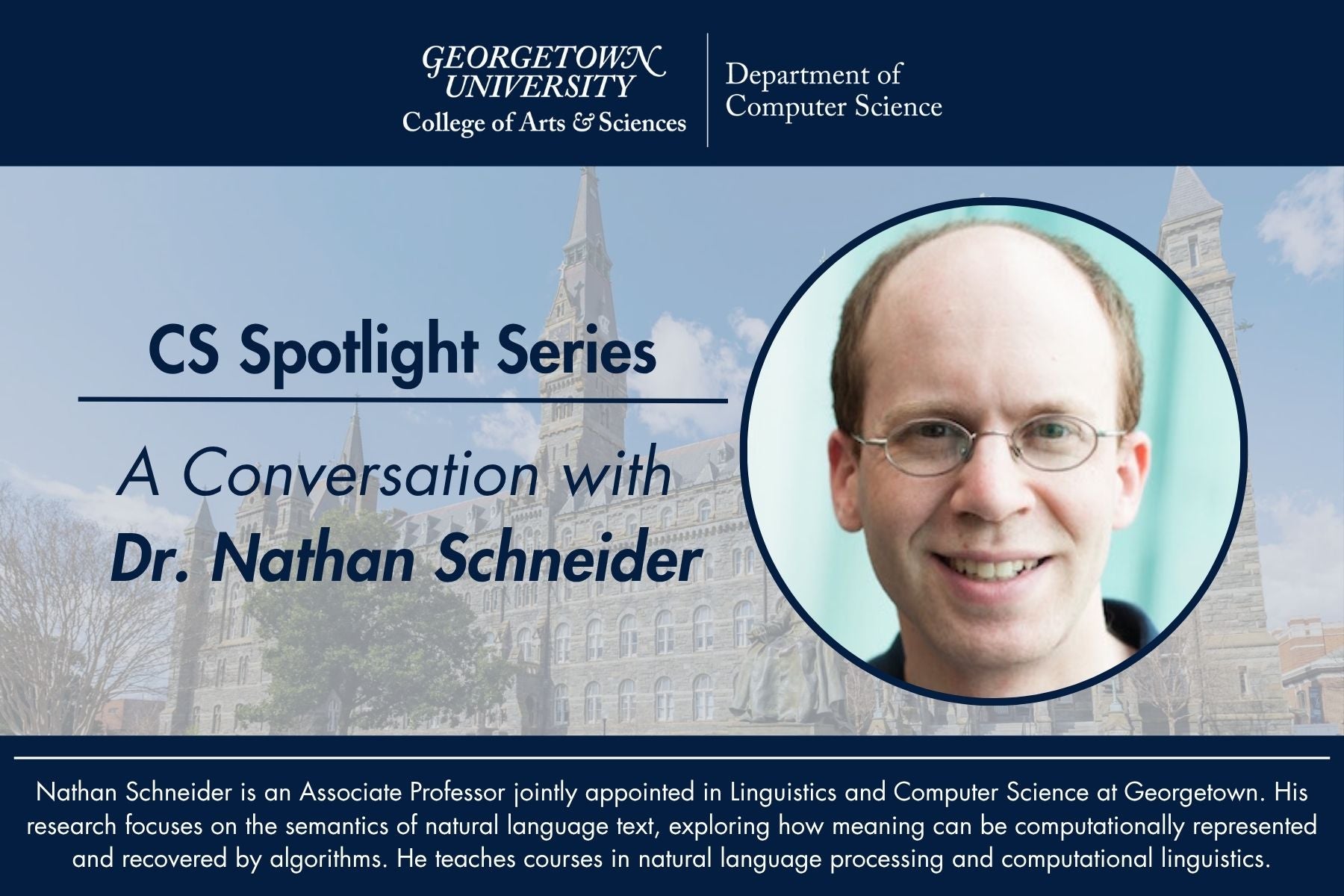
CS Spotlight Series: A Conversation with Professor Nathan Schneider
Posted in News Story | Tagged CS Spotlight Series
By Mariam Khan, Georgetown University
In this edition of the CS Spotlight Series, we sat down with Professor Nathan Schneider to learn more about his research in computational linguistics, his interdisciplinary journey, and his work with Georgetown students and collaborators.
What is your main research focus, and what motivated you to get into this area?
In my lab, we study computational linguistics and natural language processing (NLP), which is about getting computers to process human language, from converting speech to text, to translation, to answering questions. Our particular focus is on meaning: how language encodes it, how it varies across languages, and how computers can recover it.
I’ve long been interested in both computer science and language. When I discovered NLP as an undergraduate, it was a perfect fit, and it’s been exciting to see the field grow from a niche research area to something people interact with every day.
How does this research translate into real-world impact?
Language technologies power much of modern AI, most visibly in systems like ChatGPT. These tools are remarkably fluent and useful for many things, though they don’t truly “understand” language. My research explores both their strengths and their limitations, including in high-stakes settings such as legal interpretation.
What has it been like building your research and teaching career at Georgetown?
Georgetown has been an ideal environment for interdisciplinary work, with fantastic students and colleagues whose expertise ranges from linguistic theory to AI system building. My lab bridges Computer Science and Linguistics. Our collaborations have benefited from the Massive Data Institute, Tech & Society Initiative, and the Law Center as well.
One example of an exciting collaboration was contributing to an amicus brief in a U.S. Supreme Court case on firearm parts kits (“ghost guns”). Our linguistic analysis was cited in the majority opinion, an unexpected but meaningful way for research to shape policy.
What challenges and opportunities do you see in your field today?
The public spotlight on AI is both exciting and daunting. Chatbots are now the face of AI, but their black-box nature and tendency to hallucinate pose risks. We need to teach not only the technical mechanics of these systems, but also their social, ethical, and legal implications.
What advice would you give to students interested in NLP or computational linguistics?
Take an interdisciplinary approach. Language and AI are too broad for any single field to capture fully. Being able to collaborate across disciplines, as Georgetown encourages, is invaluable.
For students interested in exploring further, I recommend checking out GUCL, Georgetown’s community for computation and language research.